Case Study - HealthTasks Vision AI Skills Checkoffs Drive Clinical Skill Improvement


Clinical skills validation should produce measurable improvement, not just documentation.
In a live production deployment with 100 entry level nursing students, HealthTasks Vision AI Skills Checkoffs is generating significant, repeatable performance gains across core clinical competencies. This is not a pilot environment or simulated dataset. It is active use inside a nursing program with formal evaluation implications.
The Data
Across eight essential clinical skills, students demonstrated the following average improvements between initial and subsequent attempts:
PPE Donning and Doffing
43% → 86%
+43%
CPR Checkoff
42% → 83%
+41%
Applying Oxygen Therapy
46.5% → 83.5%
+37%
OB APGAR
33% → 67%
+34%
Manual Blood Pressure
52.3% → 81%
+28.7%
IV Catheter Insertion
70.5% → 96%
+25.5%
Glove Skills Checkoff
70% → 90%
+20%
Ambu Mask Ventilation
64% → 71%
+7%
Most foundational and safety critical skills improved between 25 and 43 percentage points. Lower baseline skills demonstrated the largest gains. Higher baseline skills showed smaller deltas, consistent with normal learning curve behavior.
This pattern supports credibility. Improvement is not uniform or artificial. It reflects real instructional correction.
Same Session Skill Correction
One of the most important findings is timing.
Students are improving within the same lab session, often within minutes to hours. Average AI grading turnaround is 30 seconds to 2 minutes. Students review structured feedback and immediately reattempt skills.
This is instructional acceleration. Instead of waiting days for manual grading and feedback, performance correction happens in real time.
The result is compressed time to competency.
Faculty Workflow Impact
Vision is not functioning as a supplemental tool. Faculty are fully deferring formative grading to automated Vision checkoffs during practice mode. Some high performing attempts are being accepted as summative grades.
Faculty time spent on formative checkoffs is effectively near zero during automated cycles.
Instructors report strong trust in scoring consistency. This is critical. Operational replacement only happens when evaluation is perceived as reliable.
Behavioral Change Before Clinical Rotations
The most unexpected signal has been student behavior.
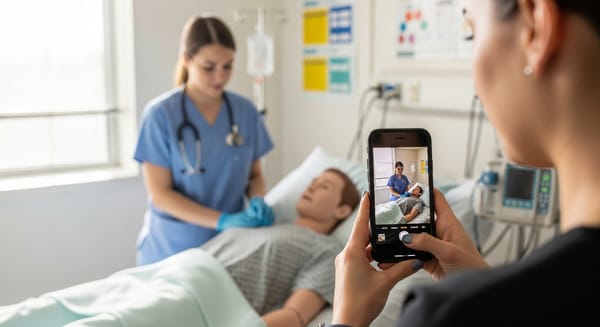
Students are voluntarily completing skills prior to the start of clinical rotations. Lab utilization has increased. Students are filming each other, acting as patients, and reviewing rubric criteria closely to avoid penalties.
The dean reports that this level of early, self directed skill preparation has not been observed in previous cohorts before Vision was introduced.
This indicates a shift from compliance based checkoffs to accountability driven preparation.
When students know scoring is consistent, granular, and immediate, they adjust behavior. Rubric adherence improves. Protocol awareness increases. Practice becomes intentional.
What This Establishes
The deployment demonstrates:
- Measurable procedural skill lift
- Same session performance correction
- Closed loop feedback without faculty bottlenecks
- Standardized scoring across students
- Voluntary early preparation behavior
- Institutional trust at the dean level
This moves skills validation beyond digitized documentation.
It introduces structured competency intelligence.
If replicated across additional institutions, this model supports a broader shift in nursing education:
Knowledge validation measures what students know.
AI driven skills validation measures what they can do and how quickly they improve.
The next phase of clinical education will not be defined by content delivery or scheduling tools. It will be defined by measurable competency progression and defensible performance data.
The early evidence suggests that real time, AI structured evaluation can accelerate skill acquisition while reducing faculty burden and increasing student accountability.
That is not incremental improvement. It is a change in how clinical competency is developed and validated.